 Richard
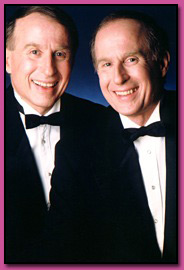
and John Contiguglia are identical twins who
have collaborated as a piano duo since they were
five years old. Throughout their career critics
have responded in superlatives to their unique
musical partnership. Following the release of
their historic recording for Connoisseur Society
of Beethoven’s 9th Symphony,
transcribed for two pianos by Franz Liszt, now a
collector’s item, critic Edward Tatnall Canby
called the Contiguglias “the most profoundly
musical pair of piano virtuosi of this century.”
Records and Recording proclaimed that “they have
given the two-piano medium a whole new
dimension. The Contiguglias stand apart in a
lofty world of their own, unrivaled and
supreme.” Byron Belt, for Newhouse News Service,
called the Contiguglias “foremost among today’s
duo-pianists.” Richard
and John Contiguglia are identical twins who
have collaborated as a piano duo since they were
five years old. Throughout their career critics
have responded in superlatives to their unique
musical partnership. Following the release of
their historic recording for Connoisseur Society
of Beethoven’s 9th Symphony,
transcribed for two pianos by Franz Liszt, now a
collector’s item, critic Edward Tatnall Canby
called the Contiguglias “the most profoundly
musical pair of piano virtuosi of this century.”
Records and Recording proclaimed that “they have
given the two-piano medium a whole new
dimension. The Contiguglias stand apart in a
lofty world of their own, unrivaled and
supreme.” Byron Belt, for Newhouse News Service,
called the Contiguglias “foremost among today’s
duo-pianists.”
Richard
and John were born of Italian immigrant parents in
Auburn, NY, the last children, and second set of
twins, in a family of seven children. Without a
doubt, the most extraordinary musical event of the
twins’ youth was a performance in their home town,
when they were 12 years old, of a group of
two-piano pieces in the middle of a solo-piano
recital by the legendary pianist-composer, Percy
Grainger. 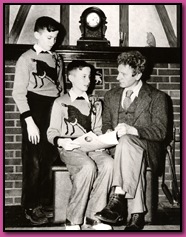 Thus began an association
with Grainger which led to a lifelong interest in
the man and his music. Following their
concert together, Grainger presented the young
pianists with many of his two-piano scores, some
with touching dedications: “To Richard and John
Contiguglia, from their admiring colleague;” “in
admiration of their splendid playing;” “in tonal
fellowship.” Throughout their career Richard and
John have programmed and recorded a great deal of
Grainger’s music. They presented an all-Grainger
chamber music concert at the Caramoor Festival in
1981; they broadcast several programs of
Grainger’s music over National Public Radio
during the Grainger Centenary Year, 1982; they
released three albums of Grainger’s music, a
Grainger-Gershwin LP for MCA Classics, a
Grainger-Bolcom CD for Helicon Records, which
included Grainger’s Lincolnshire Posy, Hill
Song No. 1, and Children’s March,
and a Grainger-Gershwin CD on the Gemini CD Classics label,
which, in addition to many Grainger favorites,
such as Country Gardens and Molly on
the Shore, includes all of the
Grainger-Gershwin transcriptions, including the
Fantasy on ‘Porgy & Bess’ for two
pianos. Thus began an association
with Grainger which led to a lifelong interest in
the man and his music. Following their
concert together, Grainger presented the young
pianists with many of his two-piano scores, some
with touching dedications: “To Richard and John
Contiguglia, from their admiring colleague;” “in
admiration of their splendid playing;” “in tonal
fellowship.” Throughout their career Richard and
John have programmed and recorded a great deal of
Grainger’s music. They presented an all-Grainger
chamber music concert at the Caramoor Festival in
1981; they broadcast several programs of
Grainger’s music over National Public Radio
during the Grainger Centenary Year, 1982; they
released three albums of Grainger’s music, a
Grainger-Gershwin LP for MCA Classics, a
Grainger-Bolcom CD for Helicon Records, which
included Grainger’s Lincolnshire Posy, Hill
Song No. 1, and Children’s March,
and a Grainger-Gershwin CD on the Gemini CD Classics label,
which, in addition to many Grainger favorites,
such as Country Gardens and Molly on
the Shore, includes all of the
Grainger-Gershwin transcriptions, including the
Fantasy on ‘Porgy & Bess’ for two
pianos.
For
over a decade the Contiguglias had performed Percy
Grainger’s masterful two-piano
Fantasy on George Gershwin’s ‘Porgy and
Bess’ on recital programs
throughout the world. As they became more familiar
with the Gershwin original, they realized that,
despite all of Grainger’s ingenuity, there were
details missing from the two-piano score which
give special meaning to the texture and color of
the music. To add these details to the Grainger
score, the Contiguglias commissioned orchestrator,
Tom Kochan, in 1993, to turn Grainger’s
Fantasy on George Gershwin’s ‘Porgy and Bess’
for two pianos alone into a Concerto for Two
Pianos and Symphony Orchestra. Of a
performance of this new-born concerto with the
Seattle Symphony in 1998, Newhouse critic Byron
Belt wrote: “The performance was a smashing
success - acclaimed by a packed Seattle Center
Opera House crowd with enthusiastic cheers. -
Grainger’s Fantasy is a superb score, the
Contiguglias, a magnificent pair of pianists, the
orchestral additions, terrific.”
An
important part of the Contiguglias’ career has
involved discovering, performing and recording
unusual and forgotten works from the duo-piano
repertoire. With the Cleveland Orchestra they
revived Victor Babin’s Concerto for Two
Pianos and Orchestra to rave acclaim from
the Cleveland press. They gave the New York
premiere with the American Symphony Orchestra in
Carnegie Hall of Max Bruch’s Concerto
for Two Pianos and Orchestra. They
gave modern-day premieres and released
first-recorded performances of many works of
Bartók and Liszt, including the former’s
Suite for Two Pianos, Op. 4b and the
latter’s transcription for two pianos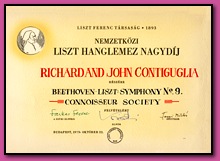 of Beethoven’s 9th Symphony.
Other modern-day, Liszt premieres included his
two-piano versions of the Operatic Fantasies
on ‘Norma’ and ‘Don Giovanni’ and the piano,
four-hand versions of the Fantasy on ‘La
Sonnambula’ and the Beethoven Fest Cantate.
Their recording of the Beethoven-Liszt 9th
Symphony was awarded a Grand Prix
by the Liszt Society of Budapest in the first
record competition of the Society’s history. The
recording was a best-seller throughout the world
and was licensed by Phillips for release in Japan,
where it created a sensation. The Contiguglias’
performance of the 9th from memory at the
1984 Holland Liszt Festival prompted a Dutch
critic to describe the Contiguglias as “in a class
by themselves” and led to three reengagements by
the Liszt Festival plus performances throughout
The Netherlands, including engagements with many
of Holland’s major orchestras. of Beethoven’s 9th Symphony.
Other modern-day, Liszt premieres included his
two-piano versions of the Operatic Fantasies
on ‘Norma’ and ‘Don Giovanni’ and the piano,
four-hand versions of the Fantasy on ‘La
Sonnambula’ and the Beethoven Fest Cantate.
Their recording of the Beethoven-Liszt 9th
Symphony was awarded a Grand Prix
by the Liszt Society of Budapest in the first
record competition of the Society’s history. The
recording was a best-seller throughout the world
and was licensed by Phillips for release in Japan,
where it created a sensation. The Contiguglias’
performance of the 9th from memory at the
1984 Holland Liszt Festival prompted a Dutch
critic to describe the Contiguglias as “in a class
by themselves” and led to three reengagements by
the Liszt Festival plus performances throughout
The Netherlands, including engagements with many
of Holland’s major orchestras.
One
of the most unusual modern-day premieres given by
the Contiguglias at the Holland Liszt Festival was
of Liszt’s unpublished duo, Grosses
Konzertstück über Mendelssohns ‘Lieder
ohne Worte’. A major, unpublished work, over
20 minutes long, the Konzertstück, based
on 3 of Mendelssohn’s Op. 19 Songs Without
Words, waited 152 years to be heard in
toto. Its scheduled premiere in Paris in
1835, by Liszt and a pupil, was cut short, when
Liszt collapsed at the piano during its
performance. Subsequent attempts to perform the
work met with equal failure. Busoni died before a
scheduled premiere in London with Egon Petri. The
originally scheduled premiere by the twins in
Utrecht, Holland, had to be canceled, because the
58 page score had been confiscated by Dutch
customs agents, suspicious that the smudged
manuscript copies from East Germany masked coded
espionage secrets. Finally, the premiere of this
‘cursed piece’ took place by the Contiguglias in
Holland and was followed by performances by them
in New York, Chicago and other American cities.
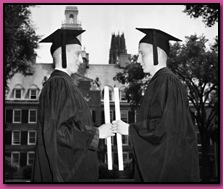 The
Contiguglias’ inquisitive musical natures
developed in part from their academic training.
They received their B.A. degrees from Yale,
summa cum laude, and were elected to
Phi Beta Kappa in their junior year. At
graduation they were awarded the Charles Seymour
Prize, jointly, for achieving identical academic
averages of 91, the highest in the graduating
class of Berkeley College, their residential
college at Yale. They received their M.Mus.
degrees from the Yale Graduate School of Music. The
Contiguglias’ inquisitive musical natures
developed in part from their academic training.
They received their B.A. degrees from Yale,
summa cum laude, and were elected to
Phi Beta Kappa in their junior year. At
graduation they were awarded the Charles Seymour
Prize, jointly, for achieving identical academic
averages of 91, the highest in the graduating
class of Berkeley College, their residential
college at Yale. They received their M.Mus.
degrees from the Yale Graduate School of Music. 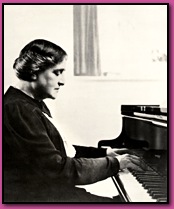 Although both twins
majored in music at Yale, John took many elective
courses in chemistry, and Richard, in English
literature and philosophy. At Yale the
Contiguglias studied piano, as soloists, with
Bruce Simonds. Subsequently, they studied the duo
repertoire for four years with the legendary
British pianist, Dame Myra Hess, who prepared them
for their important London Wigmore Hall debut and
for their first European tours. Although both twins
majored in music at Yale, John took many elective
courses in chemistry, and Richard, in English
literature and philosophy. At Yale the
Contiguglias studied piano, as soloists, with
Bruce Simonds. Subsequently, they studied the duo
repertoire for four years with the legendary
British pianist, Dame Myra Hess, who prepared them
for their important London Wigmore Hall debut and
for their first European tours.
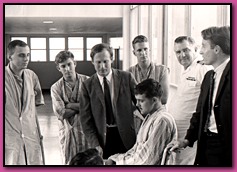 Early in their
career, during the Vietnam War years, the
Contiguglias were on a tour of the Pacific, which
took them to Hawaii and Guam. While in Guam they
gave an impromptu Christmas concert at the US
Naval Hospital. After the concert, which included
works of Mozart, Schubert, Brahms and Hindemith,
one young American told them, “Until today, I
never realized the power of great music to make
one forget the problems of this world. Early in their
career, during the Vietnam War years, the
Contiguglias were on a tour of the Pacific, which
took them to Hawaii and Guam. While in Guam they
gave an impromptu Christmas concert at the US
Naval Hospital. After the concert, which included
works of Mozart, Schubert, Brahms and Hindemith,
one young American told them, “Until today, I
never realized the power of great music to make
one forget the problems of this world.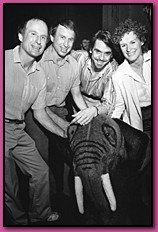 It’s better
than LSD.” Richard and John were so moved by this
experience that, when they returned to the States,
they performed, whenever possible, through
an organization called Hospital Audiences, in
veterans’ hospitals, nursing homes and mental
hospitals in the New York area. One of the
highlights of these performances for the shut-ins
was a collaboration with narrators Glenn
Close and Jeremy Irons in a performance of
Saint-Saens’ Carnival of the Animals. It’s better
than LSD.” Richard and John were so moved by this
experience that, when they returned to the States,
they performed, whenever possible, through
an organization called Hospital Audiences, in
veterans’ hospitals, nursing homes and mental
hospitals in the New York area. One of the
highlights of these performances for the shut-ins
was a collaboration with narrators Glenn
Close and Jeremy Irons in a performance of
Saint-Saens’ Carnival of the Animals.
Schubert
has always been a special love of the
Contiguglias, not least because he wrote some of
his greatest chamber music for two pianists at one
piano. One of the last directives that Dame Myra
gave to them was to “devote your lives to making
audiences aware of the Schubert duets.” Throughout
their careers the Contiguglias have striven to
introduce a wider public to this little-known
repertoire. At Schubertiade 1993 - Schubert and
the Piano at the 92nd St. Y in New York City, they
lectured and performed at the Marathon Symposium.
They were reengaged to participate at the final
Schubertiade of the 92nd St. Y’s series in 1995.
Richard
and John Contiguglia have performed with major
orchestras throughout the world, including the
Cleveland Orchestra, the Pittsburgh Symphony, the
Atlanta Symphony, the National Symphony, the
Toronto Symphony, the Boston Pops, the Netherlands
Chamber Orchestra and the Rotterdam Philharmonic.
In 1999, they were invited by conductor Jorge
Mester to perform Bartók’s Concerto for Two
Pianos, Percussion and Orchestra with the
Orquesta Filarmonica De La Ciudad De Mexico as
part of a Bartók commemorative season featuring
all of the composer’s concertos. They have
performed in numerous prestigious venues,
including Carnegie Hall and Lincoln Center in New
York, the Kennedy Center in Washington, Orchestra
Hall in Chicago, Queen Elizabeth Hall in London,
and the Concertgebouw in Amsterdam. Their recital
at the Lobero Theatre in Santa Barbara,
California, for the Music Academy of the West, was
chosen by the Santa Barbara News Press critic as
one of the “best musical events of the year 2000.”
The Contiguglia twins have been seen on national
television in Holland, Great Britain and the
United States. On Nov. 25, 2008, Richard and John
were the featured lunchtime pianists at London’s
National Gallery for Dame Myra Hess Day, 2008, an
event that called to mind the famous lunchtime
National Gallery Concerts that Dame Myra organized
during World War II. They were featured on ABC’s Live
with Regis and Kathy Lee, NBC’s The
Today Show and the A&E Channel.
An exciting development in the Contiguglias’
continuing musical career was the creation of
their
own recording company,
Gemini CD Classics, to produce and
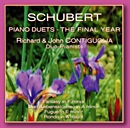
market their own CDs. Their company released five
new Contiguglia CDs, GC 100,
Schubert Piano Duets
- The Final Year,
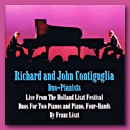
GC 101,
Live From
The
Holland Liszt
Festival,
Duos For Two
Pianos and Piano, Four-Hands by Franz Liszt, GC
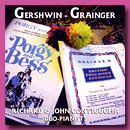
102,
Gershwin
- Grainger,
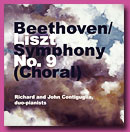
GC 103, Beethoven / Liszt Symphony
No. 9 and GC 104,
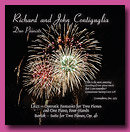
Liszt - Operatic Fantasies & Bartok -
Suite for Two Pianos.
|